The short answer
Most UK pitched roofs are cold roofs that depend on ventilation to stay dry, and spray foam can block the air paths that ventilation relies on. If foam closes the eaves gaps and bridges the loft airflow, moisture that gets in has fewer routes to dry, raising the risk of condensation and decay. Not every foamed roof loses its ventilation, but it is a core thing surveyors check. An independent survey assesses your roof’s actual airflow.
Ventilation sounds like a minor detail, but in a cold roof it is the main defence against moisture. The gaps at the eaves and the airflow above the insulation carry away water vapour before it can do harm. Spray foam can disrupt that system, which is why ventilation is one of the first things a surveyor assesses on a foamed roof. This page explains how roof ventilation works and how foam affects it.
Roof ventilation at a glance
- Cold roof relies on Eaves gaps & cross-flow airflow
- Foam risk Blocking or bridging air paths
- Consequence Less drying — higher moisture risk
- Regs reference Approved Documents C & F principles
- Assessment Inspect ventilation and timber together
How a cold roof breathes
The traditional UK pitched roof is a cold roof: the insulation sits at ceiling level and the loft above is deliberately ventilated. Gaps at the eaves let outside air in, and that air moves across the underside of the roof and out at the ridge or through tile vents. This constant trickle of air carries away the small amounts of water vapour that inevitably rise from the home below, keeping the timbers and felt dry. The building regulations recognise this: roof ventilation and resistance to moisture are addressed in Approved Documents C and F, and the underlying building science is set out by the BRE.
Without that airflow, vapour accumulates, the air in the roof stays humid, and any cold surface becomes a place for condensation to form. Ventilation, in other words, is not optional — it is how a cold roof avoids becoming damp.
How spray foam can disrupt ventilation
When foam is sprayed onto the underside of the roof slope, two problems can arise:
- Eaves gaps get filled. Foam applied right down to the wall plate can close off the very gaps that let outside air enter, cutting the airflow at its source.
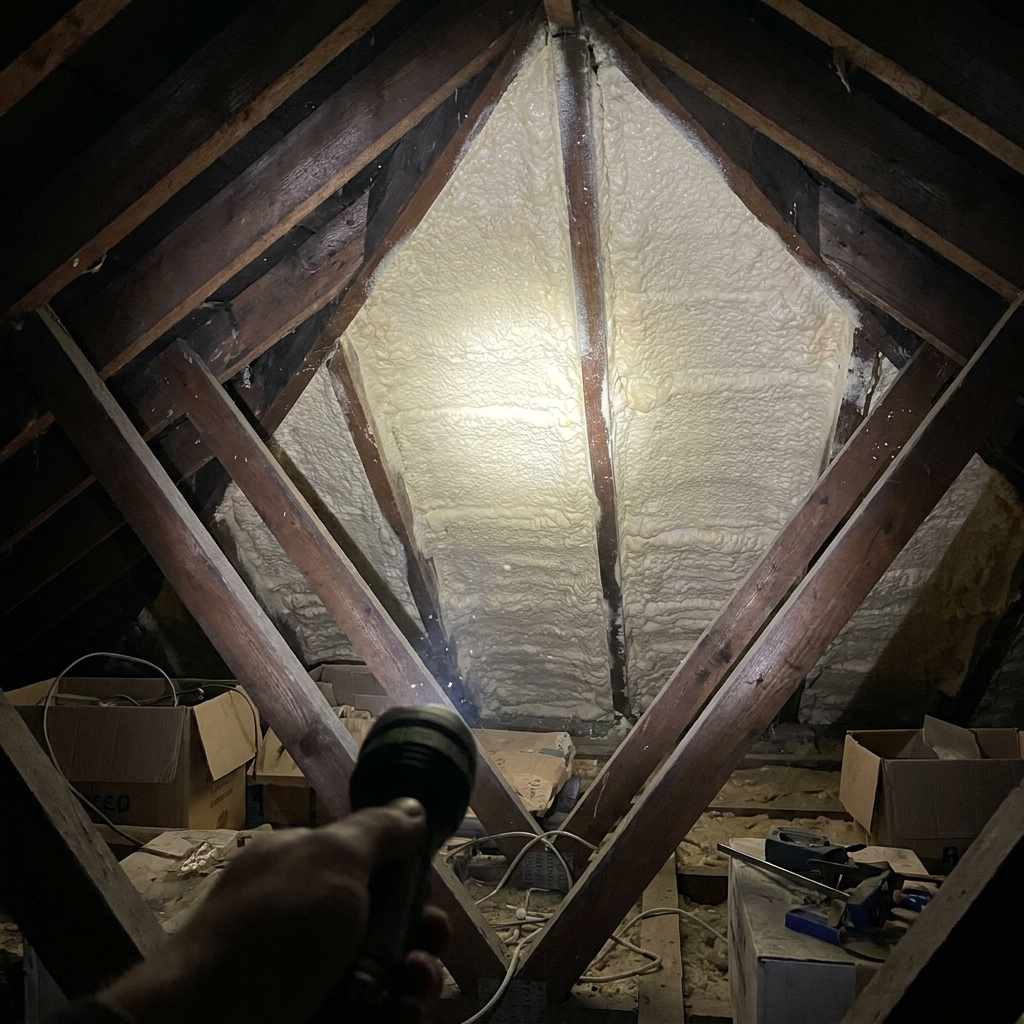
- The air path is bridged. Foam across the rafters can block the channel of moving air that would otherwise sweep the underside of the roof, so even where some air gets in it cannot circulate.
The result is a roof that can no longer dry itself the way it was designed to. Combined with reduced visibility of the timbers, this is the heart of why surveyors and the RICS guidance treat foamed roofs cautiously. It also links directly to condensation risk: less ventilation means less drying capacity.
Warm roofs and why design matters
Not all roofs need ventilation in the same way. A correctly designed warm roof deliberately has no ventilation void, relying instead on continuous insulation and proper vapour control to keep condensation at bay. The problem with much sprayed foam is that it sits between the two approaches: it reduces the ventilation a cold roof needed without necessarily delivering the airtight, vapour-controlled detailing a warm roof requires. Whether your roof falls on the safe side of that line depends on the specific design and install — a judgement only an inspection can make.
| Roof approach | How it stays dry |
|---|---|
| Cold roof (most homes) | Ventilation carries moisture away |
| Warm roof (designed) | Continuous insulation & vapour control, no void |
| Foam over a former cold roof | Depends on whether ventilation is preserved or replaced safely |
How a surveyor checks ventilation
Assessing ventilation on a foamed roof is more involved than glancing into the loft. A competent inspection looks for whether outside air can still enter at the eaves, whether there is a clear path for that air to move up the slope, and whether the ridge or tile vents remain effective. Because foam can hide the eaves detail, this often means examining the wall plate area closely and, where necessary, cutting back foam in a test location to see how far it extends and whether it has sealed the air gaps. The surveyor will also consider the home below: a property generating high humidity puts more demand on whatever ventilation remains.
What a surveyor is really judging is balance. A roof needs enough air movement to remove the moisture the building produces. If foam has reduced that air movement without any compensating change — such as a properly designed warm-roof build-up with vapour control — the roof may no longer be in balance, and moisture can accumulate. This is a judgement about the whole system, not a single measurement, which is why generic online answers cannot settle it for your roof.
What to do next
If you are unsure whether your foamed roof is still adequately ventilated, an independent inspection is the answer. A RICS surveyor or competent specialist assesses the eaves, the air paths and the timber condition together, and explains whether moisture is being managed safely. Use someone not selling removal, so the verdict is impartial. If the foam has compromised ventilation, that finding feeds into a sensible discussion about removal and, where relevant, reinsulating. This page is general information, not a survey of your roof, which an independent inspection should provide.
Frequently asked questions
Does spray foam stop a roof breathing?
It can. If foam fills the eaves gaps or bridges the loft airflow, it cuts the ventilation a cold roof relies on to stay dry. But not every installation does this — some preserve air paths. Whether your roof still ventilates adequately can only be confirmed by inspection.
Why does roof ventilation matter so much?
Most UK roofs are cold roofs that depend on moving air to carry away water vapour. Without that airflow, humidity builds up and condensation can form on cold surfaces, dampening timbers. Ventilation is the main moisture defence, which is why surveyors check it first.
Can ventilation be restored to a foamed roof?
Sometimes air paths can be reopened, but with foam in place the moisture picture is complex and depends on the whole system. An independent specialist should assess ventilation, vapour control and timber condition together before recommending any fix or removal.
Is an unventilated foamed roof always a problem?
Not necessarily — a correctly designed warm roof has no ventilation void by intention. The concern is foam that removed a cold roof’s ventilation without providing the airtight, vapour-controlled detailing a warm roof needs. Only an inspection can tell which situation you have.
Sources & further reading
- GOV.UK — Building Regulations Approved Documents C and F (resistance to moisture and ventilation)
- BRE (Building Research Establishment) — cold and warm roof ventilation principles
- RICS — Spray foam insulation consumer guidance (2023) on ventilation and inspection
- PCA (Property Care Association) — guidance on ventilation, condensation and timber health
This guide is general information, not surveying, structural, legal or financial advice. Whether spray foam needs removing depends on the foam type, install quality, ventilation and your roof timbers’ condition, and an independent inspection by a RICS surveyor or qualified specialist (not a free survey from a company that profits from removal) is essential before you decide.