The short answer
An independent spray foam survey is an impartial inspection of your roof by a RICS surveyor or qualified specialist who does not sell removal. It establishes the foam type, the ventilation and moisture conditions, and the condition of the roof timbers — the facts that decide whether removal is actually needed. Because a free survey from a removal firm is a sales visit, an independent assessment is the only reliable basis for a costly decision. It is far cheaper than removal and should always come first.
The word “survey” is doing a lot of work in the spray foam market, and not always honestly. A “free roof survey” offered by a company that sells removal is a sales appointment with a clipboard. An independent survey is something quite different: a paid, impartial inspection whose only output is an accurate picture of your roof. Understanding what a genuine independent assessment actually examines — and why each item matters — lets you tell the two apart and make a decision you can defend to a lender or a buyer.
The independent survey at a glance
- Who RICS surveyor / specialist not selling removal
- Cost Far less than removal; paid, not “free”
- Checks Foam type, ventilation, moisture, timbers
- Output Impartial written report
- When Before any removal decision
What the surveyor actually inspects
A competent independent inspection looks past the foam to the health of the roof itself. The assessor is not there to admire or condemn the insulation but to establish facts a lender or buyer can rely on. The key things assessed are:
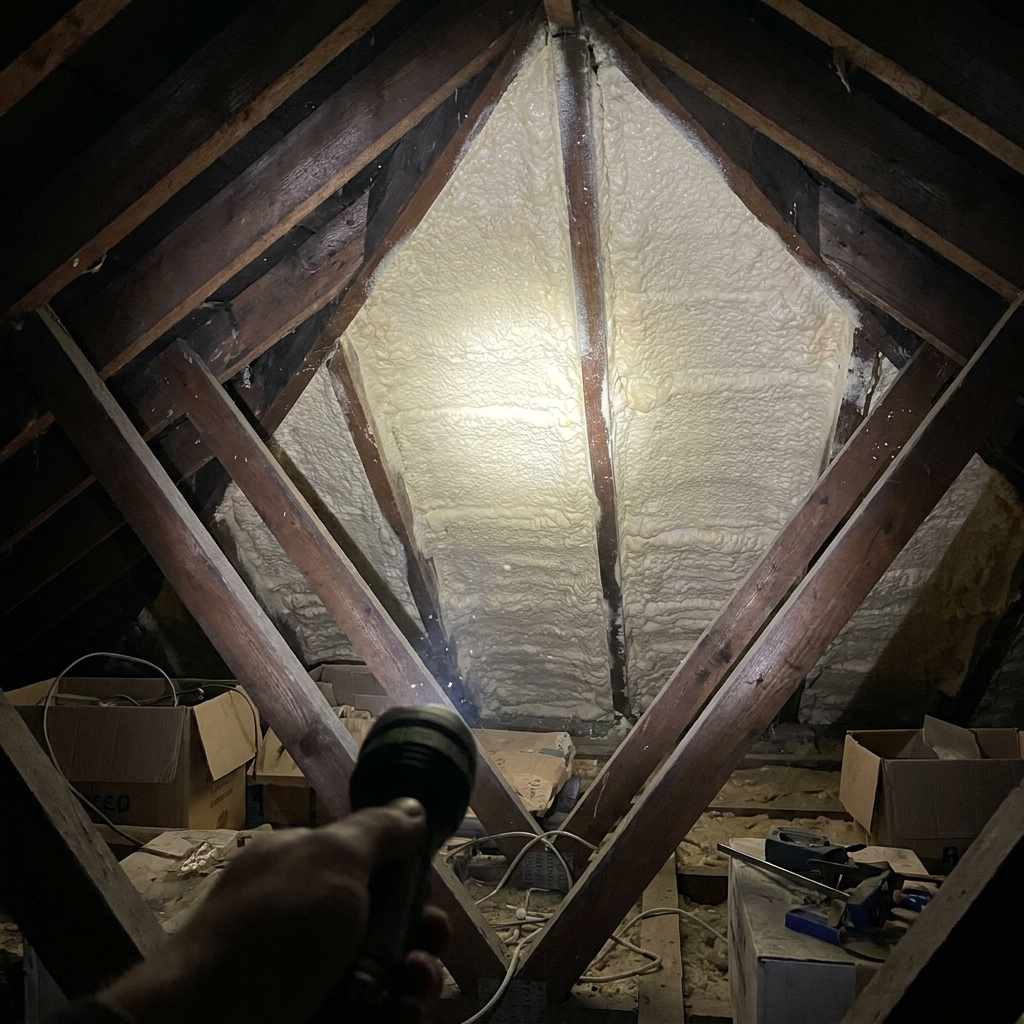
- Foam type and extent — whether it is open-cell or closed-cell, how thickly it is applied, and whether it is bonded to the felt, battens or rafters. Closed-cell foam that has bonded hard to the felt is the configuration lenders most often flag.
- Ventilation — whether the foam has blocked the roof ventilation paths the roof relies on to stay dry, which is the single most important moisture-risk question.
- Moisture and condensation — meter readings and visual signs of trapped moisture, condensation or damp at the foam-to-timber interface.
- Timber condition — the state of the rafters and battens, checking for any decay or rot wherever access allows, since one of the chief concerns is that foam can obscure deteriorating timber.
- Installation quality and documentation — whether there is evidence of correct specification, a designed ventilation strategy and any guarantee, BBA certificate or paperwork from the original install.
Why an inspection is needed at all
Lenders and surveyors are cautious about spray foam for a specific, rational reason: once applied, the foam can hide the very roof structure a surveyor would normally examine, and if it traps moisture against the timbers it can contribute to decay over time. A standard mortgage valuation may not see behind the foam, so the lender cannot easily judge the risk. An independent inspection resolves that uncertainty by examining the foam and the roof together and recording the condition in writing. This is the mechanism that turns an unknown into a documented position one way or the other.
It is worth being clear about cost and scale, because this is where the independent route makes financial sense. A focused independent inspection of a foamed roof costs a fraction of removal — a modest professional fee against a removal bill that typically runs to several thousand pounds. Spending that smaller sum first is not an extra expense; it is the step that prevents you spending the larger one needlessly. The report should be specific to your roof rather than a generic template: it should name the foam type, describe the ventilation arrangement, record any moisture readings, and state plainly whether the timbers that can be seen are sound. A vague, conclusion-led document that simply recommends removal is a warning sign in itself.
Why this beats a free survey
The difference is incentive. A removal company’s surveyor is rewarded when you agree to removal; an independent assessor is paid for the inspection regardless of the conclusion. That single fact changes the reliability of everything in the report. An impartial inspection can equally conclude that the foam is performing acceptably and does not need removing — a conclusion a removal firm has no commercial reason to reach. This is why a survey from someone selling removal cannot, by itself, justify a four-figure decision, and why RICS guidance points homeowners toward an independent professional view.
| Feature | Independent survey | Free removal-company survey |
|---|---|---|
| Who pays | You (modest fee) | “Free” — cost is in the sale |
| Incentive | Impartial — paid either way | Profits if you remove |
| Possible outcome | “No removal needed” is on the table | Almost always “remove it” |
| Use with lender | Credible, independent evidence | Often discounted as a sales document |
How the report helps you
An impartial written report is the document that actually moves things forward. It tells you whether removal is needed, it can support discussions with a lender about spray foam and mortgages or a remortgage, and if removal is justified it gives a removal firm an accurate scope to quote against — which in turn lets you compare quotes fairly. Keep the report; it is useful evidence when you come to sell. Read it alongside the RICS guidance on spray foam. This page is general information, not surveying, structural, legal or financial advice; the independent inspection itself is the essential step.
Frequently asked questions
Is an independent survey free?
No — and that is the point. A genuinely impartial inspection is paid for, so the assessor has no incentive to recommend removal. It is still far cheaper than removal itself.
Who should carry out the survey?
A RICS chartered surveyor or a qualified specialist who does not sell removal. Independence from the removal decision is what makes the report reliable.
What does the survey check?
Foam type and extent, roof ventilation, moisture and condensation, the condition of the roof timbers, and the quality and documentation of the original installation.
Will a lender accept an independent survey?
An impartial report carries more weight than a removal company's sales survey, and can support a lender discussion, but each lender sets its own requirements.
Sources & further reading
- RICS — consumer guidance on spray foam insulation and mortgage lending (2023)
- Property Care Association (PCA) — independent inspection of spray foam roofs
- GOV.UK — Building Regulations Approved Document C (resistance to moisture and ventilation)
- Building Research Establishment (BRE) — roof condensation and ventilation principles
This guide is general information, not surveying, structural, legal or financial advice. Whether spray foam needs removing depends on the foam type, install quality, ventilation and your roof timbers’ condition, and an independent inspection by a RICS surveyor or qualified specialist (not a free survey from a company that profits from removal) is essential before you decide.