The short answer
Spray foam insulation in a roof can complicate a mortgage, but it does not make a property automatically unmortgageable. Lenders react cautiously because foam can hide the roof timbers and, if poorly specified or ventilated, trap moisture. Many lenders will still lend — some with conditions, some after a satisfactory independent inspection, and a minority after removal. The outcome depends on the foam type, the install quality and the individual lender’s policy.
Sprayed polyurethane foam applied to the underside of a roof has become one of the most common reasons a residential mortgage application stalls at survey stage. The reason is rarely the foam itself in isolation — it is that the foam prevents a surveyor inspecting the rafters and felt and assessing ventilation. This page explains how lenders actually treat spray foam in 2026, what the 2023 RICS guidance changed, and the practical route to clarity.
Spray foam and mortgages at a glance
- Automatically unmortgageable? No — lender-dependent
- Main lender concern Obscured timbers & moisture risk
- Key 2023 change RICS framework to reduce blanket rejections
- First sensible step Independent RICS inspection report
- Typical removal cost £2,000–£5,000+ if needed
Why lenders care about spray foam at all
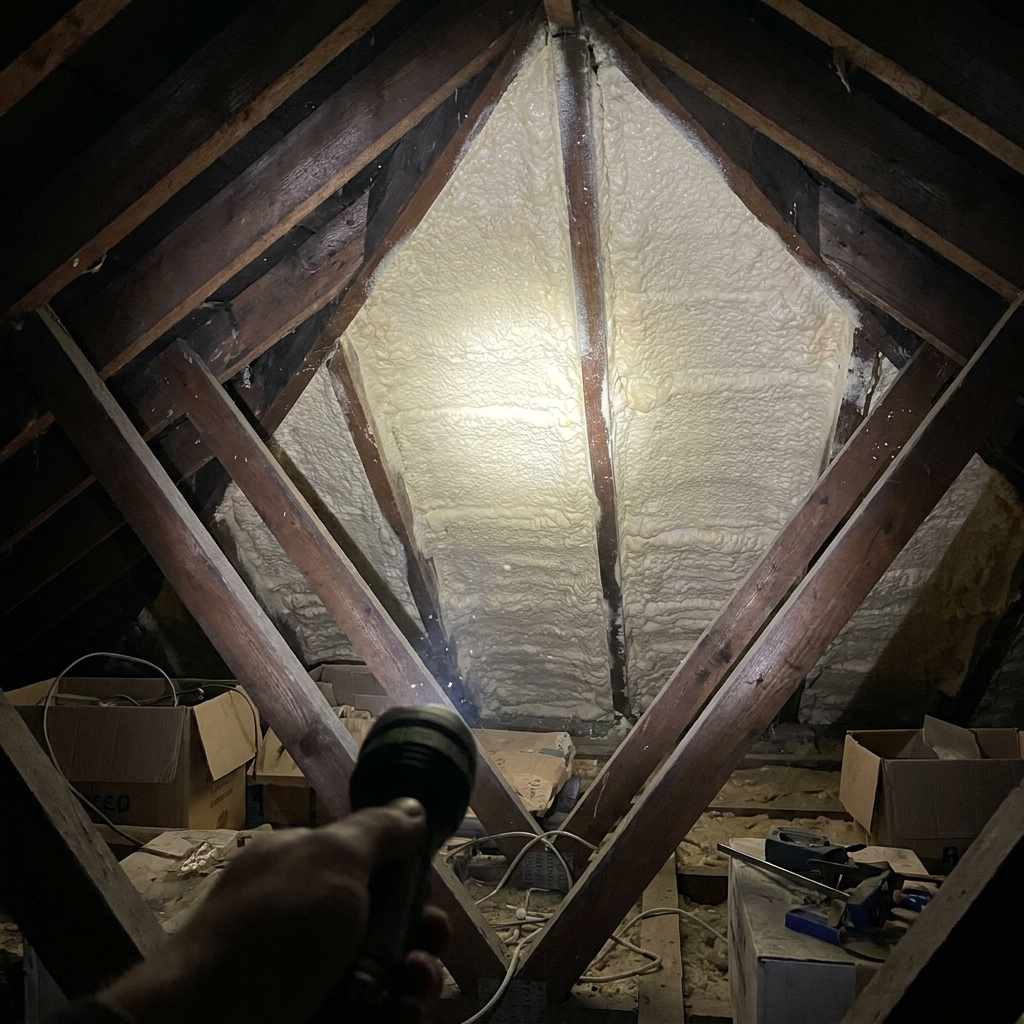
A mortgage is a loan secured against the property, so the lender needs reasonable confidence that the building is sound today and will remain saleable for the years the loan runs. To form that view they rely on a valuer, usually a RICS surveyor. When sprayed polyurethane foam is bonded to the underside of the roof, it physically obscures the rafters, the sarking felt and the ventilation path. The surveyor cannot see whether the timbers are sound, whether condensation is forming behind the foam, or whether the roof can breathe. Faced with that uncertainty, a cautious valuer may flag the roof as a risk and recommend the lender treats the property accordingly.
It is important to be precise about the mechanism, because owners often assume the objection is that foam is inherently dangerous. It is not. Correctly specified, ventilated and installed foam can perform perfectly well. The objection is narrower and more practical: the foam removes the surveyor’s ability to verify the roof’s condition. On top of that, some installations — particularly dense closed-cell foam sprayed directly onto the felt with no ventilation gap — can restrict airflow and, if moisture becomes trapped against the timbers, contribute to decay over time. A valuer who cannot rule that out, and a lender who must protect a long-term loan, both respond by pricing the uncertainty conservatively. The foam itself may be fine; what the lender is really reacting to is the inability to prove it.
What lenders actually decide
There is no single “UK lender position” on spray foam. Each lender is an independent business that sets its own lending criteria and risk appetite, and those policies vary widely and change over time. In practice you will encounter four broad responses:
- Lend normally — some lenders accept the property with no special condition, especially where the valuer is satisfied or the install is documented.
- Lend with a retention or condition — the lender may hold back part of the funds, or make completion conditional on receiving a satisfactory inspection report.
- Require an independent inspection report — a clear report from a suitably qualified specialist can sometimes resolve the concern without any removal at all.
- Require removal, or decline — a minority insist the foam is removed first, or will not lend on the property in any circumstances.
Because policies differ so much, the same house can be declined by one lender and accepted by another in the same week. That single fact should change how you respond to a setback: a refusal is one lender’s view, not a verdict on the property. It is also exactly why a whole-of-market mortgage broker is so valuable — they track which lenders are currently comfortable with sprayed roofs and can steer your application towards them rather than away from a deal.
| Lender response | What it means for you |
|---|---|
| Accepts as standard | Proceed; no foam-related action needed |
| Inspection report required | Commission an independent report; removal may be avoidable |
| Retention / condition | Funds held or completion conditional; provide evidence |
| Removal required | Obtain quotes; budget £2,000–£5,000+ |
| Declines | Move to a more flexible lender via a broker |
What the 2023 RICS guidance changed
In 2023 RICS — the professional body that sets standards for chartered surveyors — published consumer-facing guidance on spray foam insulation and mortgage lending. Its purpose was to give surveyors a clearer, more consistent framework for assessing sprayed foam, and to reduce the blanket “foam present, therefore decline” reactions that had become common and were leaving owners of perfectly sound homes unable to sell or remortgage. The guidance encourages a proportionate, evidence-led assessment — judging the roof on its actual condition rather than on the mere presence of foam — and recognises that a competent independent inspection can establish whether the roof is sound. Crucially for homeowners, it acknowledges that such an inspection can sometimes give a lender the assurance it needs without removal. The guidance did not make foam universally acceptable, and it does not bind any individual lender to lend, but it did push the market away from reflexive refusals and made a good independent report more useful than ever.
The financial consequence, and what to do next
The practical impact of all this is felt in three ways: a narrower pool of willing lenders, a potential drag on valuation and saleability, and the risk of a stalled chain at the worst moment. The good news is that the cure is usually cheaper than the fear. The single most useful step is an independent inspection by a RICS surveyor or qualified specialist who does not sell removal. A clear report on the foam type, ventilation and timber condition gives you, your buyer and any lender something concrete to work with — and it typically costs a fraction of the £2,000–£5,000+ that removal can run to. Pair that report with a whole-of-market broker who can match you to an accommodating lender. Only consider removal if an independent report or a specific essential lender genuinely requires it; treating removal as the automatic first move usually means spending thousands you may not have needed to.
This page is general information, not surveying, structural, legal or mortgage advice. An independent inspection and a qualified broker are essential before you make any decision.
Frequently asked questions
Does spray foam make a house impossible to mortgage?
No. It can complicate an application and some lenders decline, but many will lend — sometimes with conditions, sometimes after a satisfactory independent inspection, and only occasionally requiring removal. It is lender-dependent, not universal.
Is open-cell or closed-cell foam more of a mortgage problem?
Closed-cell foam is more often flagged because it is denser, bonds hard to timbers and felt and can restrict ventilation. Open-cell is more vapour-open. Either way, an independent inspection establishes the real risk.
Will the 2023 RICS guidance get my mortgage approved?
Not by itself. The guidance gives surveyors a clearer framework and discourages blanket rejections, but each lender still sets its own policy. A good independent report plus the right lender is what resolves most cases.
Should I remove the foam before applying for a mortgage?
Not automatically. Get an independent inspection first — removal is far more expensive than an inspection and may not be required by your chosen lender.
Sources & further reading
- RICS — 2023 consumer guidance on spray foam insulation and mortgage lending
- UK Finance — mortgage lending and property condition positions
- Property Care Association (PCA) — guidance on spray foam in roofs and condensation risk
- GOV.UK — Building Regulations Approved Document C (resistance to moisture)
This guide is general information, not surveying, structural, legal or financial advice. Whether spray foam needs removing depends on the foam type, install quality, ventilation and your roof timbers’ condition, and an independent inspection by a RICS surveyor or qualified specialist (not a free survey from a company that profits from removal) is essential before you decide.