The short answer
There is no single answer: some UK lenders accept spray foam, some lend with conditions, some require an independent inspection, and a minority require removal or decline. Each lender sets its own policy, so the same property can be accepted by one and refused by another. A whole-of-market broker and a clear independent inspection report are the practical way to find a lender that will accept your roof.
“Which lenders accept spray foam?” is the question that decides many sales and remortgages — and there is no universal list, because policies change and vary by lender. What stays constant is the logic: lenders worry that foam hides the roof and can trap moisture, and they manage that uncertainty in different ways. This page explains the spectrum of lender attitudes and how to find one that will lend.
Lender acceptance at a glance
- One universal policy? No — varies by lender
- Most accommodating outcome Accept as standard
- Common middle ground Accept with inspection report
- Strictest outcome Require removal or decline
- Best navigation tool Whole-of-market broker
Why there is no single answer
Mortgage lenders are independent businesses, each with its own lending criteria and risk appetite. There is no industry-wide rule, regulation or RICS standard that requires or forbids lending on spray-foamed roofs, so attitudes vary widely from one lender to the next. One lender may treat a foam-insulated roof as a non-issue and proceed as normal; another may want an inspection report; another may decline outright. These policies also shift over time as lenders review and update their criteria, which means even a list of “accepting lenders” can date quickly. The practical lesson is that you should never conclude a property is “unmortgageable” on the strength of a single refusal — it simply means that one lender, on that day, under its current policy, was not comfortable.
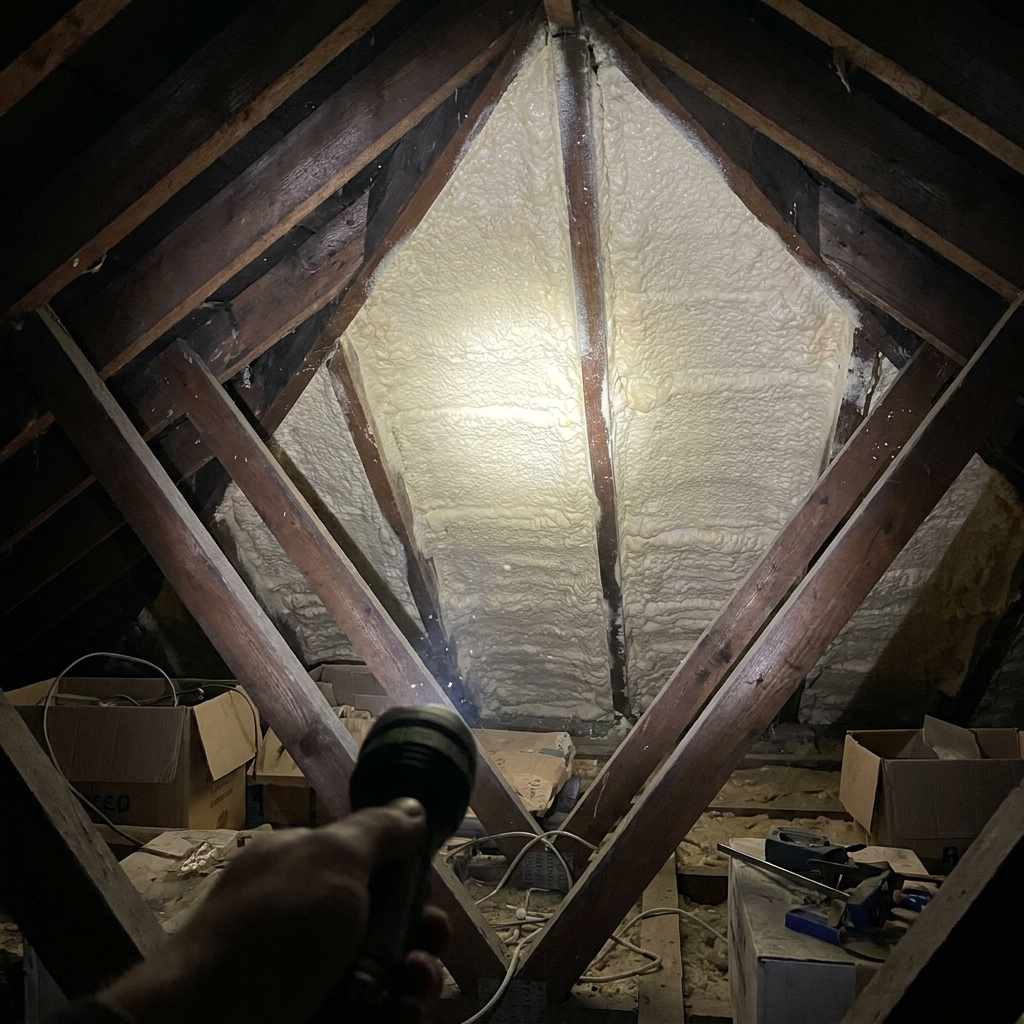
Underneath all the variation sits one shared concern. The foam obscures the rafters, the felt and the ventilation path, preventing a valuer from verifying the roof’s condition; and where dense closed-cell foam is unventilated, there is a recognised risk of trapped moisture against the timbers. Every lender is reacting to that same uncertainty. What differs is how each one chooses to manage it — some absorb the risk, some price it with conditions, some refuse to take it on at all.
The spectrum of lender responses
- Accept as standard — some lenders proceed wherever their valuer is satisfied, with no special condition attached.
- Accept with a satisfactory inspection report — a clear independent report on the foam type, ventilation and timber condition can resolve the concern without any removal.
- Accept with a retention or condition — funds held back, or completion made conditional on receiving evidence or carrying out work.
- Require removal — a minority insist the foam comes out before they will lend.
- Decline — some lenders will not lend on a foam-insulated property at all, regardless of evidence.
The same house can therefore sit anywhere on this spectrum depending purely on which lender is asked. That is liberating once you understand it: your job is not to “fix” the house to suit every lender, but to find the lender whose policy already fits your house.
| Lender response | Likely trigger |
|---|---|
| Accept as standard | Valuer satisfied; documented install |
| Accept with report | Foam present but no visible defects |
| Accept with retention | Lender wants evidence before releasing all funds |
| Require removal | Unverifiable timbers / cautious policy |
| Decline | Evidence of damp or decay; strict policy |
How the 2023 RICS guidance helps
The 2023 RICS consumer guidance on spray foam and mortgage lending gave surveyors a clearer, more consistent framework for assessing sprayed roofs, and explicitly aimed to reduce the blanket rejections that had become common. While it does not bind any individual lender to lend, it has encouraged a more proportionate, evidence-led approach across the market — surveyors are pointed towards judging the actual condition of the roof rather than reacting to the mere presence of foam. The knock-on effect for homeowners is significant: a good independent inspection report is more useful than ever, because it supplies exactly the evidence the guidance asks surveyors to weigh. See the RICS guidance explained for detail.
How to find a lender that will accept your roof
The practical route is straightforward, and it puts you in control rather than at the mercy of a single valuation:
- Commission an independent inspection so you can evidence the roof’s real condition rather than leaving every lender to assume the worst.
- Use a whole-of-market mortgage broker — they track which lenders currently accept sprayed roofs and can place your application accordingly, avoiding lenders certain to decline.
- Provide documentation — product data sheets, certificates and any competent-person paperwork that supports the quality of the install.
If one lender declines, a broker can usually identify a more accommodating one rather than abandoning the deal entirely. Removal should be a genuine last resort, considered only when an inspection or a specific essential lender genuinely requires it — not the reflex response to a single “no”.
This page is general information, not mortgage or surveying advice. Lender policies change — confirm current criteria with a qualified broker and obtain an independent inspection.
Frequently asked questions
Is there a list of lenders that accept spray foam?
Not a reliable fixed list — policies vary by lender and change over time. A whole-of-market broker tracks current attitudes and can place your application with a lender comfortable with sprayed roofs.
Why do some lenders accept foam and others refuse?
Because each lender sets its own criteria and risk appetite. There is no industry-wide rule, so the same property can be accepted by one lender and declined by another on the same day.
Will an inspection report make lenders accept the foam?
Often it helps significantly. Many lenders will accept a property with a satisfactory independent report on the foam type, ventilation and timber condition — sometimes avoiding removal entirely — but it does not guarantee any specific lender’s decision.
If one lender refuses, is the house unmortgageable?
No. A single refusal reflects one lender’s policy, not the whole market. A broker can usually find a more accommodating lender, so don’t assume removal is required after one decline.
Sources & further reading
- RICS — 2023 consumer guidance on spray foam insulation and mortgage lending
- UK Finance — lending criteria and property condition positions
- GOV.UK — mortgages and home finance guidance
- Property Care Association (PCA) — spray foam and roof ventilation guidance
This guide is general information, not surveying, structural, legal or financial advice. Whether spray foam needs removing depends on the foam type, install quality, ventilation and your roof timbers’ condition, and an independent inspection by a RICS surveyor or qualified specialist (not a free survey from a company that profits from removal) is essential before you decide.