The short answer
Yes, you can often get a mortgage on a property with spray foam insulation — but not from every lender, and sometimes only with conditions. Approval depends on the foam type, the quality of the installation, the roof’s ventilation and timber condition, and the lender’s policy. A satisfactory independent inspection report and a whole-of-market broker dramatically improve your odds, and can sometimes avoid removal entirely.
“Can I get a mortgage on this house?” is the question every buyer asks the moment they spot foam under the rafters. The honest answer is usually “yes, with the right lender and the right paperwork” — but the path matters. This page sets out what makes a foam-insulated property mortgageable, what trips applications up, and the steps that move a borderline case into an approval.
Mortgaging a foam property at a glance
- Possible? Often yes, lender-dependent
- Biggest help Independent inspection report
- Second biggest help Whole-of-market broker
- Common condition Satisfactory report before completion
- Worst case Removal required or declined
The short answer, explained
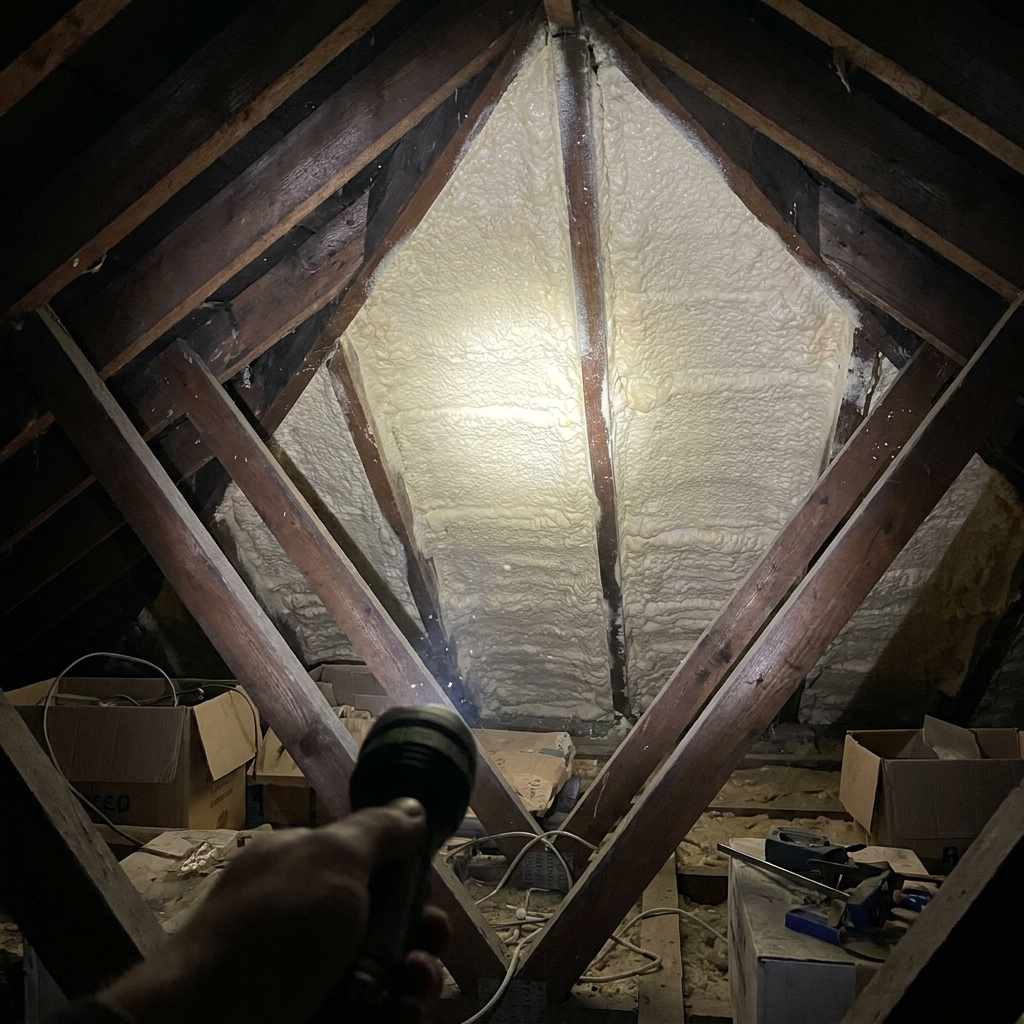
Most buyers can secure a mortgage on a property with sprayed roof foam, but the route is less predictable than on a standard roof. The lender’s valuer must be satisfied that the security is sound. Where the foam obscures the rafters, the felt and the ventilation path, the valuer cannot directly verify that condition — so the lender either accepts the property, asks for evidence in the form of an independent report, imposes a condition or retention, or, less commonly, declines. The variable here is the lender, not the law: there is no rule, regulation or industry standard that bans lending on foam-insulated homes. What you are navigating is a patchwork of individual lender policies.
This is why two buyers can have completely opposite experiences on near-identical houses. One applies to a lender comfortable with sprayed roofs and completes without incident; the other applies to a cautious lender and is refused. Understanding that variability is the key to managing it — because it means a single “no” is rarely the end of the road, and a well-evidenced application can change the answer. See our overview of spray foam and mortgages for how lenders form these views in the first place.
What improves your chances
The more certainty you can give the valuer and the lender, the more likely you are to be approved. The most influential factors are:
- An independent inspection report — a clear assessment of the foam type, ventilation and timber condition from a RICS surveyor or qualified specialist gives the lender the verification a basic valuation cannot. This is the single most powerful document you can hold, and it often costs a fraction of removal.
- Records of the installation — the product data sheet, any competent-person scheme certificate, and evidence the foam was specified for the particular roof build-up rather than sprayed indiscriminately.
- Evidence of ventilation — where the installer preserved a ventilation gap or used a more vapour-open approach, this directly addresses the surveyor’s core concern about trapped moisture.
- A whole-of-market broker — brokers know which lenders are currently accepting sprayed roofs and which to avoid, saving you from burning an application on a lender certain to decline.
- The right survey level — commissioning a more detailed survey can document the roof condition properly rather than leaving the lender’s valuer to assume the worst.
What holds applications up
Applications stall most often where there is no documentation and no independent report, leaving the valuer with pure uncertainty and a lender that must price it conservatively. Several specific factors push a lender towards caution: dense closed-cell foam applied straight onto the felt with no ventilation; signs of damp, staining or condensation; and a valuer’s note that the timbers simply cannot be inspected. A roof already showing visible problems — sagging, moisture ingress, or evidence of decay — is a genuine concern rather than a perceived one, and an inspection should investigate it properly before you commit to the purchase. The distinction matters: “the roof cannot be assessed” is a paperwork problem an inspection can solve, whereas “the roof is decaying” is a physical problem that may need remediation.
| Situation | Likely outcome |
|---|---|
| Documented install + clean independent report | Many lenders will proceed |
| No paperwork, no report | Higher chance of conditions or decline |
| Evidence of damp or decay | Remedial work likely needed first |
| Closed-cell, no ventilation, unverifiable timbers | Expect a report request or removal condition |
The practical sequence
Approach it in order rather than reacting to each obstacle as it appears. First, commission an independent inspection — this tells you whether the roof is actually a problem or simply unverified, and it gives you a document to hand to lenders. Second, engage a whole-of-market broker and share the report so they can match you to a suitable lender from the outset. Third, only if a specific essential lender or the inspection report requires it, obtain removal quotes and weigh the £2,000–£5,000+ cost against the benefit. Most buyers find the inspection alone unlocks a lender, at a fraction of removal cost — and they avoid spending thousands on work that was never required. The order protects both your purchase and your money.
This is general information, not mortgage, surveying or legal advice. Always obtain an independent inspection and speak to a qualified broker before you commit.
Frequently asked questions
Will every lender refuse a house with spray foam?
No. Some accept it as standard, some lend with conditions, and only a minority require removal or decline. The outcome depends on the lender and the evidence you can provide about the roof.
Do I need to remove the foam to get a mortgage?
Often not. A satisfactory independent inspection report can sometimes reassure a lender without removal. Get the inspection first — it is far cheaper than removal and may make it unnecessary.
What document helps most with a mortgage application?
An independent inspection report from a RICS surveyor or qualified specialist not selling removal. It establishes the foam type, ventilation and timber condition the valuer otherwise cannot see.
Can a broker help if my lender refuses?
Yes. A whole-of-market broker knows which lenders currently accept sprayed roofs and can move your application to a more accommodating one rather than abandoning the purchase.
Sources & further reading
- RICS — 2023 consumer guidance on spray foam insulation and mortgage lending
- UK Finance — lending criteria and property condition guidance
- Property Care Association (PCA) — spray foam, ventilation and moisture guidance
- GOV.UK — home buying and surveys guidance
This guide is general information, not surveying, structural, legal or financial advice. Whether spray foam needs removing depends on the foam type, install quality, ventilation and your roof timbers’ condition, and an independent inspection by a RICS surveyor or qualified specialist (not a free survey from a company that profits from removal) is essential before you decide.