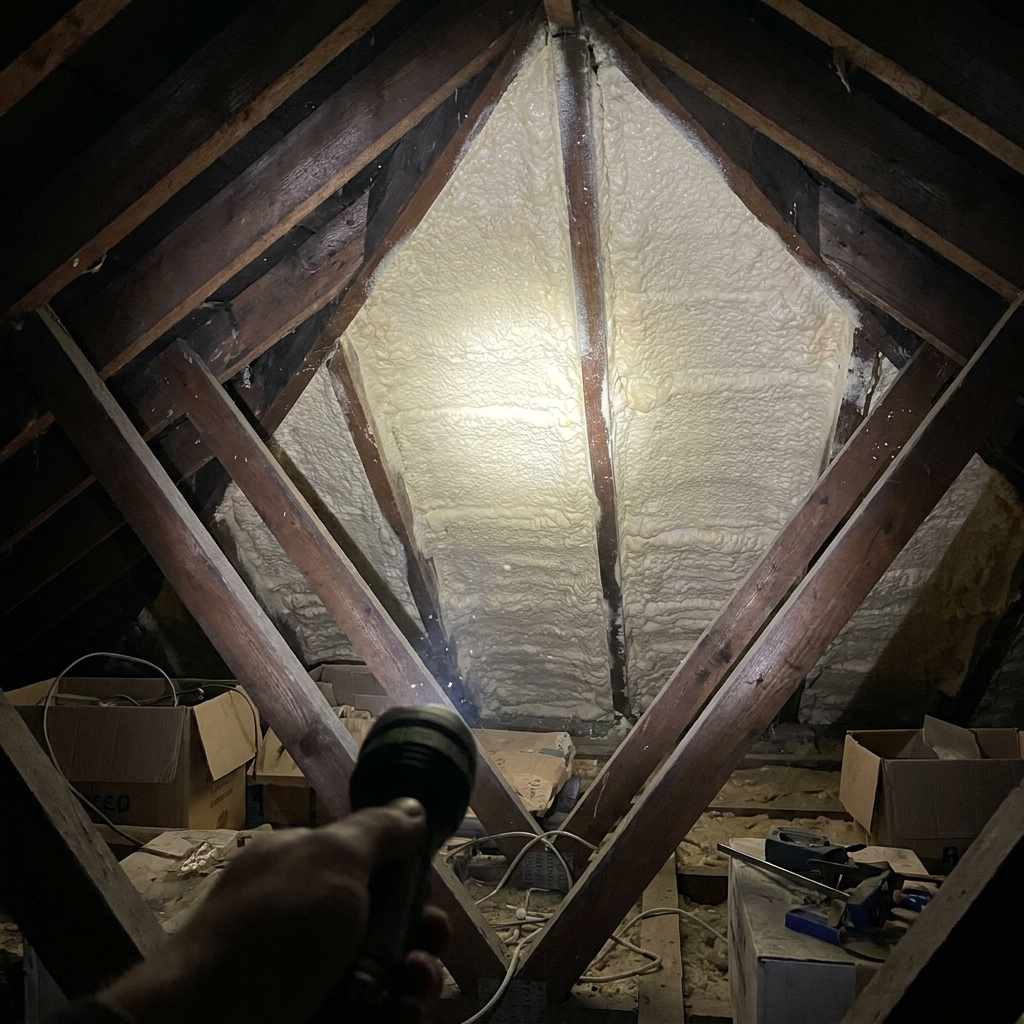
The short answer
Open-cell foam is soft, lighter and relatively vapour-open; closed-cell foam is dense, rigid and acts as a vapour barrier. The difference is not cosmetic: closed-cell bonds harder to timbers and felt, is more likely to trap moisture against the roof if the design is wrong, and is more expensive to remove. Both are flagged by cautious lenders, but closed-cell tends to attract more scrutiny. Which you have affects both the moisture risk and the cost of removal.
“Spray foam” is a single label for two materials that behave quite differently. When a surveyor inspects a foamed roof, one of the first things they establish is which type was used, because it changes the moisture physics, the inspection difficulty and the removal price. Understanding the distinction helps you read your own situation rather than relying on a removal firm’s sales pitch — though confirming the type and assessing the timbers still needs an independent professional.
Open-cell vs closed-cell at a glance
- Open-cell density Lower — soft, spongy
- Closed-cell density Higher — hard, rigid
- Open-cell vapour More vapour-open / breathable
- Closed-cell vapour Vapour barrier
- Removal Open-cell easier; closed-cell harder & dearer
- Lender concern Both flagged; closed-cell scrutinised more
The core physical difference
The names describe the cell structure of the cured foam. In open-cell foam the tiny bubbles are interconnected, so the material is soft, lower in density and more open to the passage of water vapour. In closed-cell foam the bubbles are sealed, giving a dense, rigid material with a higher insulation value per centimetre that also acts as a vapour barrier. That single property — vapour-open versus vapour-closed — drives almost every practical consequence that follows, from how the roof handles moisture to how much it costs to take the foam off again. It is the reason a surveyor wants to know the type before saying anything about risk.
| Property | Open-cell | Closed-cell |
|---|---|---|
| Density | Low | High |
| Feel | Soft, spongy | Hard, rigid |
| Vapour behaviour | More open | Vapour barrier |
| Insulation per cm | Lower | Higher |
| Bond to timber/felt | Moderate | Strong |
| Removal effort & cost | Lower | Higher |
Why the difference matters for moisture
A pitched roof has to deal with water vapour rising from the home — from cooking, bathing, drying clothes and simply breathing. In a traditional cold roof, that vapour passes up and is carried away by ventilation at the eaves and ridge. Closed-cell foam sprayed at the rafter line is a vapour barrier in the wrong place: if it is applied over old felt or without a designed ventilation strategy, vapour can condense and sit against the timber, which over time risks decay. Open-cell foam is more vapour-open, but it can equally allow moisture to migrate through and reach a cold felt layer where it condenses, then have no easy route to dry out. Neither type is automatically safe; the outcome depends on the whole roof design — see roof ventilation.
Why the difference matters for removal
Closed-cell foam is denser and bonds harder, so it is slower, dustier and more expensive to strip — more sanding back of the residual skin, more labour, more disposal weight. Open-cell foam tends to break and crumble, so it generally comes off faster and cleaner. This is one of the biggest variables in a removal quote, alongside roof size and access, and it is why two homeowners with similarly sized roofs can receive very different prices. See what affects removal cost for how this feeds into the price, and how foam is removed for the mechanics.
- Closed-cell: harder bond, more labour, higher cost, more disposal weight.
- Open-cell: softer, quicker to break out, generally cheaper to remove.
- Either type over old felt complicates removal because the felt may lift with the foam.
- Foam depth: a thick application of either type adds labour over a thin skim.
Why the difference matters to lenders
Both types are commonly flagged because either can obscure the roof structure from a valuer. However, surveyors often treat closed-cell with more caution because its rigidity and vapour-barrier behaviour make hidden condensation and bonded-on timbers more likely. That said, a RICS-led inspection looks at the actual roof, not just the label — a well-ventilated, sound roof can be acceptable regardless of type, and a poorly ventilated one is a concern either way. The label is a starting point for the conversation with a lender, not the conclusion.
How to find out which you have
You usually cannot tell reliably by eye from the loft hatch — both can look like a continuous layer of foam, and density is hard to judge without touching and testing it. A surveyor or qualified specialist will confirm the density, check the bond to the timbers and assess moisture, sometimes cutting a small inspection patch. Do not rely on a removal company’s identification alone if they also want to sell you the strip-out, because the type they report directly affects the price they quote. This page is general information, not surveying or financial advice; an independent inspection is essential before any decision on removal.
Frequently asked questions
Is closed-cell or open-cell spray foam worse for a roof?
Neither is automatically worse, but closed-cell is scrutinised more because its rigidity and vapour-barrier behaviour raise the risk of trapped moisture and bonded-on timbers. The actual risk depends on the roof’s ventilation and timber condition.
Is closed-cell foam harder to remove?
Yes. It is denser and bonds harder, so removal is slower, dustier and more expensive than open-cell, which tends to break and crumble away more easily.
Can you tell open-cell from closed-cell by looking?
Often only roughly — open-cell is soft and spongy, closed-cell is hard and rigid. A surveyor or specialist should confirm the type and assess the timbers properly.
Do lenders treat the two types differently?
Some surveyors are more cautious about closed-cell, but a proper inspection looks at the whole roof. A sound, ventilated roof of either type can be acceptable; a poorly ventilated one is a concern regardless.
Sources & further reading
- RICS — Spray foam insulation consumer guidance (2023)
- BRE — Building Research Establishment guidance on vapour control and roof condensation
- PCA — Property Care Association on roof ventilation and moisture in insulated roofs
- GOV.UK — Building regulations Approved Document C, resistance to moisture
This guide is general information, not surveying, structural, legal or financial advice. Whether spray foam needs removing depends on the foam type, install quality, ventilation and your roof timbers’ condition, and an independent inspection by a RICS surveyor or qualified specialist (not a free survey from a company that profits from removal) is essential before you decide.